Lafayette Comes to Harrisburg
How Pennsylvania's Capital Welcomed the Nation's Guest in 1825

During the Marquis de Lafayette's tour of the United States in 1824 and 1825, he made a short stop in Harrisburg. Adored by the city, his presence evoked in Harrisburg the patriotic pride of a nation celebrating its fiftieth birthday.
Early on Sunday morning, January 30, 1825, Pennsylvania Governor John Andrew Shulze received a crisp three-word message: “Here we come!” The note’s purpose was, in effect, to tell Harrisburg to brace for what was next. As the governor read the words, a cavalcade was rumbling up from York bearing the “Nation’s Guest.” Although it was Sunday, crowds nevertheless filled the streets in anxious expectation. They had been alerted earlier by the ringing of bells, which announced, in clear, distinct tones, the coming of the Marquis de Lafayette to Harrisburg.
Lafayette entered the Pennsylvania capital as part of his grand tour of the country. Invited by President James Monroe to celebrate the nation’s fiftieth anniversary, Lafayette left France for New York in 1824. Accompanied by his son, he would visit all twenty-four states in thirteen months. The last surviving major general of the American Revolution, the country gave the sixty-six-year-old Lafayette a hero’s welcome. Forty-seven years earlier, the young Lafayette, spurred by emerging Enlightenment ideals of liberty and democracy, bought and outfitted his own ship, crossed the Atlantic, and offered his military services to the Continental Congress without pay in 1777. Appointed a major general at just twenty years of age, Lafayette fostered a close relationship with George Washington and commanded troops at several important battles. Now, the country was eager to celebrate his return with pomp and ceremony.
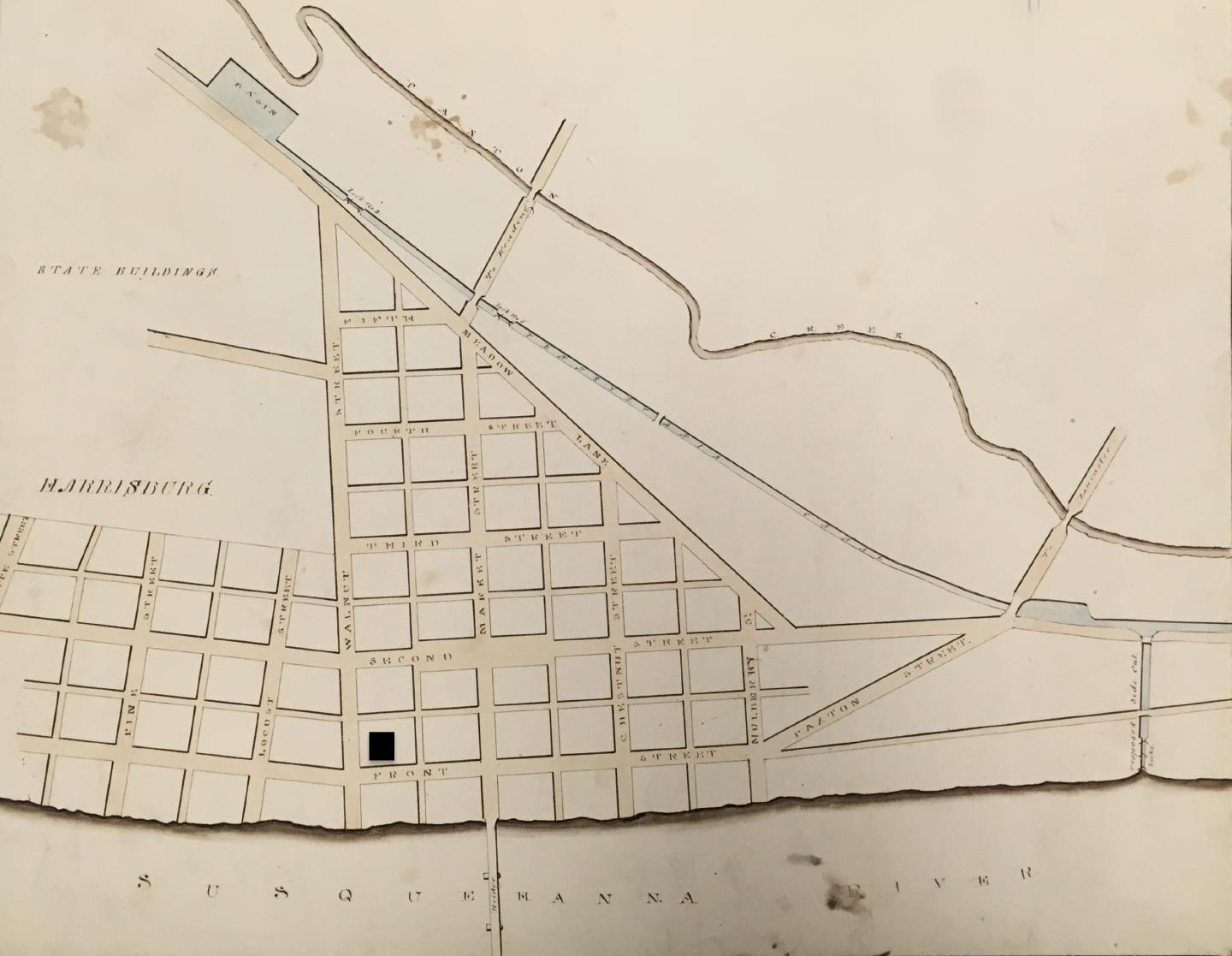
By the time Lafayette arrived in Harrisburg on January 30, the city had had little time to prepare. Lafayette was visiting the Virginia state legislature in Richmond when Harrisburg residents were startled to read in the January 25 edition of the Richmond Enquirer that the Frenchman would be leaving for Harrisburg the next day. Lawmakers in Harrisburg quickly passed a resolution authorizing Governor Shulze to draw funds from the treasury for Lafayette’s reception and accommodation. The legislature established a committee of arrangement to oversee his stay. There was also the matter, made more difficult by the short notice, of where Lafayette would lodge. Although some lawmakers contemplated renting out a suite of rooms in the city, the Assembly ultimately accepted Governor Shulze’s request to host their guests at his residence on 27 N. Front Street.
Shulze first met Lafayette in Philadelphia in 1824 and invited him to visit Harrisburg to tour the new Capitol building, which had been completed in 1822. After being elected, Shulze leased part of the residence on Front Street from architect Stephen Hills, who had built the home as his personal residence in 1812 but was forced to sell it to businessman Jacob Haldeman around 1825 because of financial trouble. When Lafayette arrived, the Shulze, Hills, and Haldeman families occupied the residence. Later known as the Haldeman-Haly House, it is today part of the McCormick Riverfront Library complex.
Lafayette entered Harrisburg from York at 5:00 p.m. on Sunday, and was escorted amid cheering crowds to the Front Street residence. There, he dined with the speakers of both houses, the committee of arrangement, and other government officials. Members of the legislature streamed through the house throughout the night to meet him.
The next morning, Lafayette was welcomed by a Mr. Hawkins, a member of the committee of arrangement, with the high-flying oratory that characterized his visit. “After an absence of more than forty years,” Hawkins announced, “we behold you as if rising from your tomb, casting your eyes about upon the nation in whose cause you unsheathed your sword at an early age, without incentive other than that fire for liberty, which jeopardized your life, rank, and fortune.” Now, Lafayette was “an object of universal wonder and admiration.”
Lafayette then endured another day of introductions. Arriving at the Capitol at 11:00 a.m., he greeted lawmakers, lawyers, government officials, and ordinary citizens who wished to meet the famous man. During his four hours at the Capitol, he shook upwards of a thousand hands. Later that evening, Lafayette, a prominent member of the Masons, visited the Perseverance Masonic Lodge #21.
At 10:00 a.m. the next day, Lafayette’s last full day in Harrisburg, cavalry in complete uniform paraded through the streets. Once again, the schedule was packed with introductions. Escorted by a volunteer battalion, he arrived at the Capitol at noon, and a cannon fired thirteen times in his honor as he stepped down from his carriage. He was then formally introduced to the House and Senate and exchanged speeches with the respective speakers of the chambers.
In his speech, Senate leader William Marks recalled the revolutionary days. “You will, no doubt,” he told Lafayette, “be gratified to behold . . . a relic of the revolutionary times.” Hanging in the Senate Chamber was, Marks said, the first American flag to be flown in the English Channel, created under the direction of Benjamin Franklin. In response, Lafayette said he was grateful to remember those “remote times” under “our beloved George Washington.”
At about 2:00 p.m., students from Dickinson College greeted him. The Pennsylvania Intelligencer noted the honed aristocratic patience and charm that Lafayette showed the students. “The cordiality with which every person was received was peculiar—was indescribable, and as such filled the crowd with the highest enthusiasm.”
The final event commemorating Lafayette’s visit was a dinner held at the State Capitol hotel that night. 120 men attended the dinner, including the governor, lawmakers, judges, and Revolutionary War veterans. Dozens of attendees gave a dizzying array of toasts. Lafayette toasted to thirteen items. A defender and advocate for women’s rights, he gave his final toast to women: “‘Tis our delight, to love, our pride to defend, our ambition to deserve her.” After the toasts—and much drinking—the whole room stood up and belted a rendition of “Hail Columbia.” At 8:00 p.m., Lafayette and the governor went home. With the man of the hour gone, the party ended shortly afterwards.
The next morning, on Wednesday, volunteer troops paraded in market square and saluted Lafayette at the governor’s mansion. At 11:00, he departed, beginning his journey to the Deep South.
Amid the patriotic speeches and remembrances that looked back to the nation’s birth, Lafayette’s language also looked forward. At his farewell dinner, he toasted to the soil of the United States. “Trod by freemen alone,” declared the ardent opponent of slavery, “it shall never want freemen to defend it.” As Lafayette headed south into the heart of slavery, he could hardly have missed the contradiction between the nation’s ideals and its institutions. The question of freedom would have to be answered by future generations. “Upon the youth of the United States," he told the students of Dickinson College, “we depend for the preservation of the free institutions and republican spirit.”
A full list of resources used in this story can be found here.Images